
How to Check Criminal History in Acadia Parish
No single Acadia Parish search answers every records question. Start with the event and the result needed. A recent arrest points first to the jail roster and arresting agency. A filed felony points to the Acadia Parish Clerk of Court. A city misdemeanor may remain in Crowley, Rayne, or Church Point court. A person reviewing their own fingerprint-linked Louisiana record must use the Louisiana State Police Right to Review channel.
Before searching, gather the full name, date of birth, likely arrest date, spelling variants, and any case or booking number. Then use the narrowest official source:
- Check the APSO Zuercher population portal or Acadia LAVNS for current custody.
- Ask the arresting agency for its incident or arrest report.
- Search open district files at the clerk’s free public terminal, or request a paid clerk search.
- Check the proper city court for an in-city misdemeanor, ordinance, ticket, or city warrant.
- Order a certified disposition or Right to Review record when formal proof is needed.
The Acadia Parish Sheriff’s Office shows the main local law-enforcement entry point.

That source is most useful for sheriff contacts and present custody, not as a substitute for a court disposition.
Four Acadia Criminal Record Custodians
A police report, jail booking, court file, and LACCH rap sheet are separate records. APSO or a city police department writes the incident and arrest narrative. Corrections staff create the booking event. The district or city clerk preserves filed charges and outcomes. BCII receives qualifying fingerprint and disposition submissions for Louisiana Computerized Criminal History. One office may not possess another office’s record.
| Record | Primary custodian | Best use |
|---|---|---|
| Incident or arrest report | Arresting agency | Authority and circumstances |
| Booking or custody | APSO Corrections | Intake, bond, housing, release |
| Filed criminal case | District or city clerk | Charges, minutes, plea, outcome |
| Louisiana rap sheet | LSP BCII | Fingerprint-linked state history |
The Acadia Parish Clerk of Court documents the parish court-record channel.

Its public terminal and Criminal Department are the correct path once a district charge has been filed.
Custody changes the office to call. The state directory separately lists the Acadia Parish Detention Center at 1061 Capital Avenue, 337-788-8740, and the Acadia Parish Jail at 337-788-8737. Those labels do not prove that each site has a separate 190-bed capacity. Use the sheriff’s verified system-wide figure only in that limited form. Questions about a court setting still belong with the clerk, not jail staff.
Official Louisiana Background Checks
Louisiana is a closed-record state. The LSP Bureau of Criminal Identification and Information does not provide an unrestricted public name search. Its Internet Background Check system is account-based and limited to requesters and purposes authorized by law. For self-review, a person may obtain a certified copy of their own LACCH history through Right to Review and fingerprint capture in the Louisiana Applicant Processing System.
Applicants use IdentoGO enrollment channels selected through current LSP instructions. Delivery may be mailed or electronic. A secure electronic result uses identity questions, expires after 30 days, and permits one retrieval. The mail authorization lists $26 and two FBI FD-258 cards, while live scheduling may add vendor charges and the $5 state technology fee. Confirm the total during enrollment.
The official LSP forms collection supplies the current authorizations and Right-to-Review material.
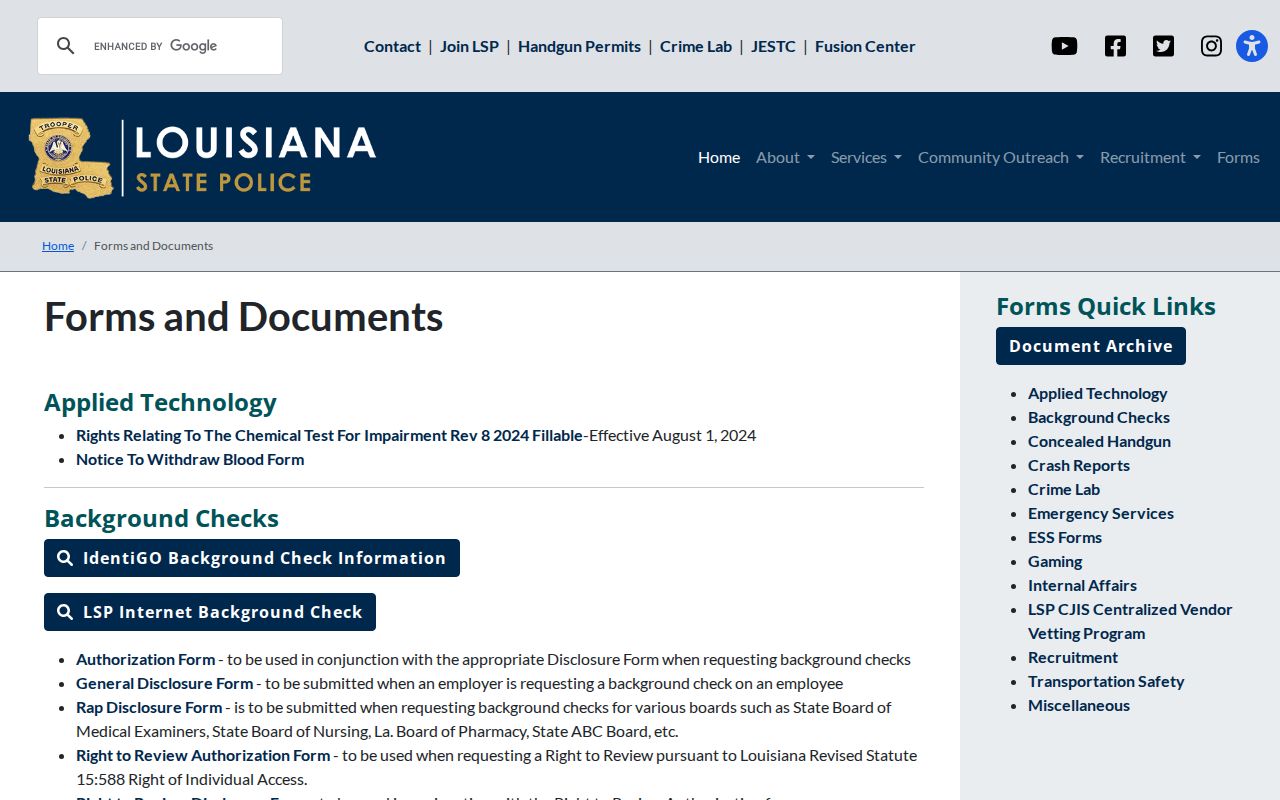
Using the current form matters because the service code, delivery choice, and authorized purpose can change the required submission.
Acadia Criminal Records at Terminal
The courthouse public terminal is free for open district-court files. The Criminal Department can also run a $20 search. The clerk describes standard coverage as 1979 forward in one place and a 30-year search in another, so older needs should be stated clearly. Old indexes remain available during normal hours, while surviving older files may require a set appointment.
| Clerk product | Official amount |
|---|---|
| Criminal search | $20 |
| Plain disposition | $10 |
| Certified disposition | $15 |
| Transcript or public copy | $1 per page |
| Mailed copy | $2 per page |
| Minute entry | $10 |
The 15th Judicial District Court identifies the court serving Acadia Parish.
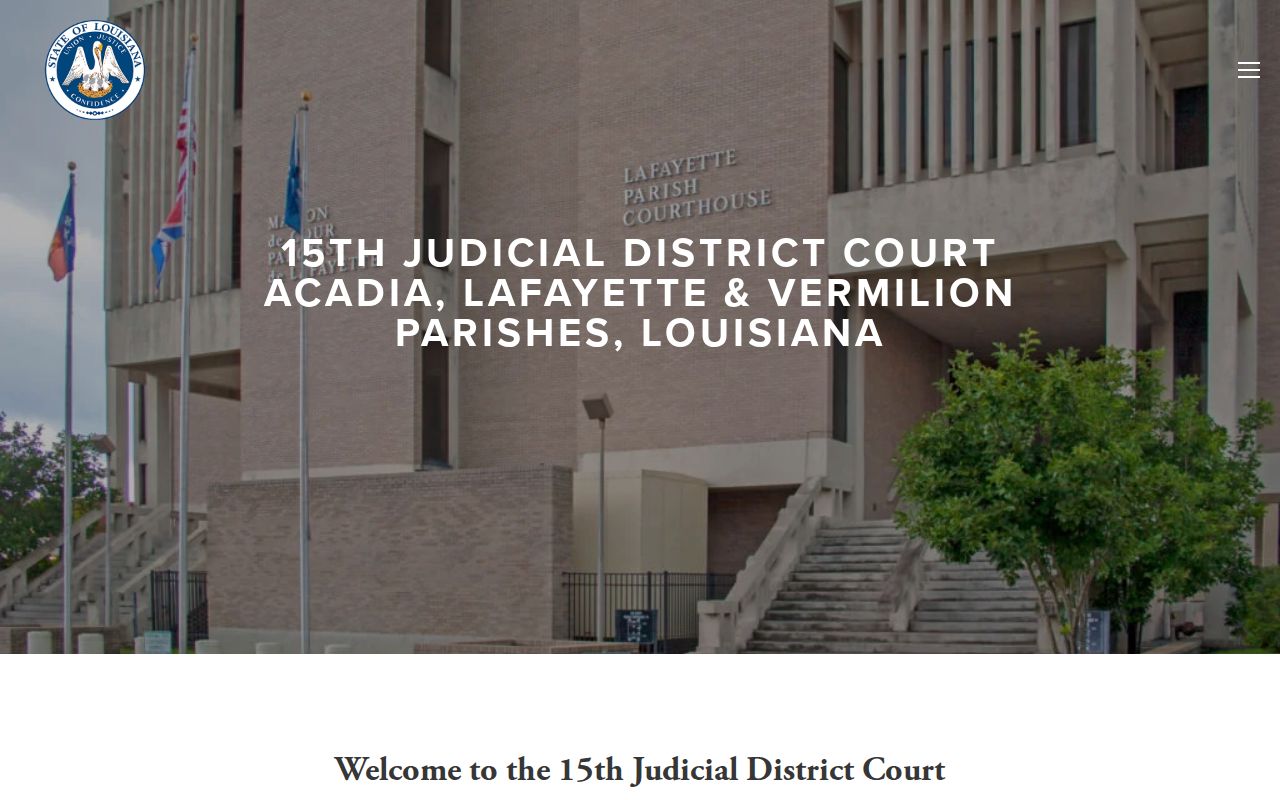
Acadia’s Divisions A, F, and J sit within that larger district, which also covers Lafayette and Vermilion parishes.
The Criminal Department is available at 337-788-8881, extension 5002, or criminal@acadiaparishclerk.com. Minute clerks preserve the official outline of proceedings, issue subpoenas, post motions and orders, and maintain introduced evidence. Sealed files do not appear on the public terminal. Readers who need an accessible visit can consult the district court’s disability-accommodation channel before traveling, since current parking and security details were not verified.
Note: Clerk Connect criminal conversion was still described as transitional, so confirm remote scope before paying for access.
Types of Criminal Records
Acadia Parish criminal records reflect different stages. An incident report describes an investigation. An arrest report explains why an agency took someone into custody. A booking record logs jail intake, while a charging instrument records what the prosecutor filed. The court file then tracks pleas, motions, judgment, and sentence.
- Arrest and booking records: agency allegations and jail intake, not proof of guilt.
- Criminal court files: filed counts, settings, minutes, motions, and dispositions.
- Warrants: court authority handled through law enforcement or the issuing court.
- Custody and supervision: parish jail, state prison, probation, or parole status.
- Registry records: public notification under a separate Louisiana statute.
For deeper court detail, use the Acadia Parish Criminal Court Cases page. Recent jail and agency routes are organized on Acadia Parish Arrest History.
Acadia Criminal Charges Timeline
A booking can appear well before a court case. The 15th Judicial District Attorney says the arresting agency generally sends its file four to six weeks after arrest. A prosecutor is then assigned and generally reviews it within 30 days. Most charges proceed by bill of information; offenses punishable by death or life require indictment.
After filing, the clerk allots the case and sets arraignment. Misdemeanors commonly receive a trial date. Felonies move through motions, pretrial work, discovery, and sometimes a preliminary hearing. This sequence explains why a jail roster may show a name while the clerk has no case yet.
The district attorney’s official site identifies the charging office and its functions.

The prosecutor’s file-transfer timetable should guide follow-up calls, but it does not guarantee that a charge will be filed.
Jurisdiction matters just as much as timing. The 15th JDC has original criminal jurisdiction over Acadia felonies. An in-city misdemeanor or ordinance matter can remain in a municipal or city court, while a parish misdemeanor filed by information or indictment can reach district court. A search limited to Court Circle may therefore miss a valid Crowley, Rayne, or Church Point court record.
What an Acadia Parish Criminal Record Shows
The fields depend on the source. LACCH can contain state and FBI identifiers, fingerprint-linked arrest cycles, charges, dispositions, sentences, incarceration, and supervision events. A clerk file adds case number, allotted judge, counsel, settings, minutes, pleas, orders, and judgment. A jail roster is narrower and more current.
| Name & Identifiers | Name, aliases, date of birth, descriptors, and repository identifiers where lawful. |
|---|---|
| Arrest / Booking Data | Arrest date, agency, intake cycle, alleged charges, warrants, bond, and release fields. |
| Charges & Statutes | Original and amended counts with Louisiana law citations. |
| Disposition | Dismissal, acquittal, plea, guilty judgment, or other court result. |
| Sentence | Custody, probation, fines, restitution, and concurrent or consecutive terms. |
| Custody / Supervision | Jail, prison, probation, or parole event, subject to access limits. |
- Disposition
- The final result for a charge.
- Nolle prosequi
- A prosecutor’s decision to end a charge.
- Minute entry
- The clerk’s official summary of a court proceeding.
- Capias
- A court command to take a person into custody.
Acadia Jail Record Portals
APSO Zuercher is the sheriff’s current public jail-population portal. Acadia LAVNS provides an alphabetical roster and anonymous custody notifications. Its observed list includes name, date of birth, race, gender, arrest date, an offender count, and a last-updated stamp. Statewide LA VINE also supports name, location, and ID or case-number searches and updates about every 24 hours.
If a very recent booking is missing, call APSO Corrections at 337-788-8737 or 337-788-8735. Transport, spelling, and update delays can affect results. The verified APSO corrections system has 190 beds, but that figure should not be copied onto every separately listed Acadia facility.
Use the DPS&C inmate information instructions for statewide custody and phone-locator options.
The statewide phone locator at 225-383-4580 can provide a housing assignment, facility contact, and projected release date when supplied with a name and date of birth or DPS&C number. LAVNS notifications are available at 866-528-6748. Neither service supplies the arresting agency’s full narrative, the prosecutor’s filing decision, or a certified court outcome. Each answers a custody question.
Note: A roster’s arrest date is not a clerk filing date, and a release date does not prove dismissal.
Public Access Laws
The Louisiana Public Records Law begins with a presumption of access, but the actual custodian remains the right request point. Investigative files, juvenile information, victim data, and private identifiers may be withheld or redacted. Louisiana criminal-history dissemination is also closed by statute, so public access to a court file does not create public access to LACCH.
Key statutes:
R.S. 44:1 defines Louisiana public records and custodians.
R.S. 15:579 protects repository security and limits juvenile dissemination.
C.Cr.P. art. 971 states the effect and purpose of expungement.
C.Cr.P. art. 983 governs expungement costs and exemptions.
R.S. 14:133.7 restricts publication of specified protected records.
The BCII criminal-history source illustrates the state repository’s distinct access rules.
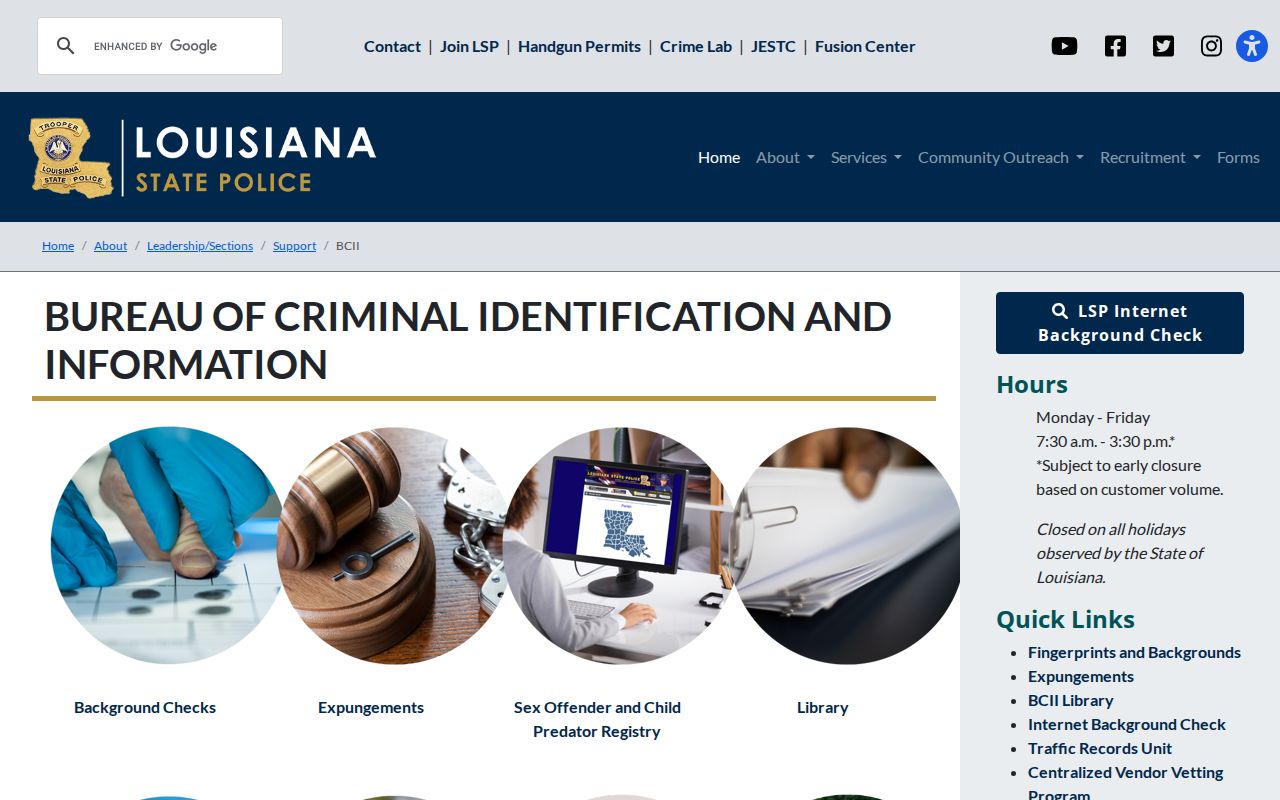
That closed repository should never be described as an open Acadia Parish people-search portal.
Acadia Warrant Search Limits
No verified public APSO active-warrant database exists. APSO Traffic and Bonds handles warrants, bonds, fines, and related appearances at 337-788-8710 or 337-788-8709/8711. Rayne City Court does publish an Active Warrants page, but its live fields and refresh schedule were not verified. Crowley City Court and Church Point Town Hall should be called for their own municipal channels.
A person resolving their own possible warrant should identify the issuing court, obtain the case or citation number, ask about bond or contempt amounts and the required appearance, and seek written proof after recall or satisfaction. Database clearance can lag. An absent name on a web list is not proof that no warrant exists.
The clerk describes one limited contempt-warrant process in which payment goes to APSO before service of a new court date. That example is not a rule for every warrant. Sealed search warrants, sealed indictments, and juvenile warrants will not be open. Never approach another person based on a listing; direct questions about one’s own status to the issuing court and APSO Traffic and Bonds.
Sealed, Expunged & Restricted
Louisiana expungement removes eligible material from public access; it does not destroy the record. Authorized justice agencies and other users named by law may still receive it. Arrest material, fingerprints, photographs, dispositions, and a same-offense failure-to-appear warrant can fall within an order. DNA is excluded. Juvenile records follow separate Children’s Code procedures.
Acadia applicants file with the court holding the record. The current local total is $550: $200 clerk, $250 BCII, $50 district attorney, and $50 sheriff. Traffic cases add $50 for the motor vehicle agency. Exemptions apply in qualifying cases, and the clerk warns that completion may take up to six months after the signed order reaches the state.
After relief, check both the clerk’s public view and the person’s Right-to-Review history. If a disposition is missing, send BCII an original certified disposition that matches the arrest date and accounts for every original and amended charge.
Felony eligibility is offense and history specific. Louisiana law includes routes tied to an article 893(E) set-aside, a clean ten-year period after completion, or a qualifying first-offender pardon. Many crimes of violence, sex offenses, and offenses against minors remain excluded. Interim expungement and redaction solve narrower record problems. Filing relief should follow the statutory forms, not an improvised request letter.
Acadia Probation and Parole
Adult felony probation and parole are state supervised through Louisiana DPS&C. The clerk lists 337-262-5444 for felony probation and a separate 337-740-0845 line for misdemeanor probation. The Louisiana Board of Pardons and Committee on Parole makes parole decisions, while DPS&C officers handle community supervision.
There is no verified public Acadia probation-name database. LA VINE may show community supervision, but sentencing minutes and certified dispositions remain better proof of a court-ordered term. Officer notes, treatment records, and third-party information can remain confidential.
The Louisiana Probation and Parole program explains the state structure.
That structure explains why the sheriff or district clerk may confirm a sentence but not disclose the full supervision file.
Criminal Records by City in Acadia Parish
City police create their own incident records, and local courts may keep misdemeanors, ordinances, tickets, and warrants outside the district clerk’s search. Crowley, Rayne, and Church Point therefore need distinct starting points. APSO still holds parish booking data, while the Acadia clerk holds district filings.
Crowley Criminal History
11,216 · Police requests and Crowley City Court routing.
Rayne Criminal History
6,983 · Police, City Court calendar, and warrant channels.
Church Point Criminal History
4,179 · Counter requests and mayor’s-court routing.
Acadia Federal Criminal Records
Federal records are not an extension of Acadia Parish court files. Acadia lies in the Western District of Louisiana, Lafayette Division. PACER supplies federal dockets under its current fee schedule, the Bureau of Prisons locator covers federal custody, and the FBI Identity History Summary gives the subject a nationwide fingerprint-linked record for an $18 base fee.
The Western District of Louisiana is the official federal court source.
A federal search should supplement, not replace, Acadia district, city, jail, or Louisiana repository checks.
Acadia Criminal Data Context
Official FBI 2019 city counts provide historical context, not current safety predictions. Crowley reported 158 violent and 528 property offenses; Rayne reported 20 violent and 186 property offenses; Church Point reported 39 violent and 78 property offenses. City population and reporting practices differed, and the data are dated. They should not be used to infer that a specific person or place is unsafe.
The FBI Crime Data Explorer is the official source for agency-reported crime data.
Always preserve the reporting year and agency scope when citing those Acadia Parish figures.