
Arrest History in Acadia Parish
The Acadia Parish Sheriff's Office makes parish arrests and operates the corrections system. Crowley, Rayne, and Church Point police create their own arrest and incident reports. Louisiana State Police may also be the arresting agency. APSO can hold the booking even when a city police department owns the narrative, so one request rarely supplies every part of an event.
An arrest record documents legal authority and alleged conduct. Booking is the jail's administrative intake. A court case begins only when a prosecutor files. For broader routing by custodian, use the Acadia Parish criminal history overview. For formal charge evolution and outcome, continue to Acadia Parish criminal court cases.
Search the APSO Zuercher Roster
APSO's current online custody route is the Zuercher portal. It is free and is the first check for a recent booking, but the research could not verify every current result field without using a private person's profile. Search by name and treat the display as a current-population tool, not a complete lifetime arrest history.
The official APSO Zuercher current jail population is shown in the captured view below.
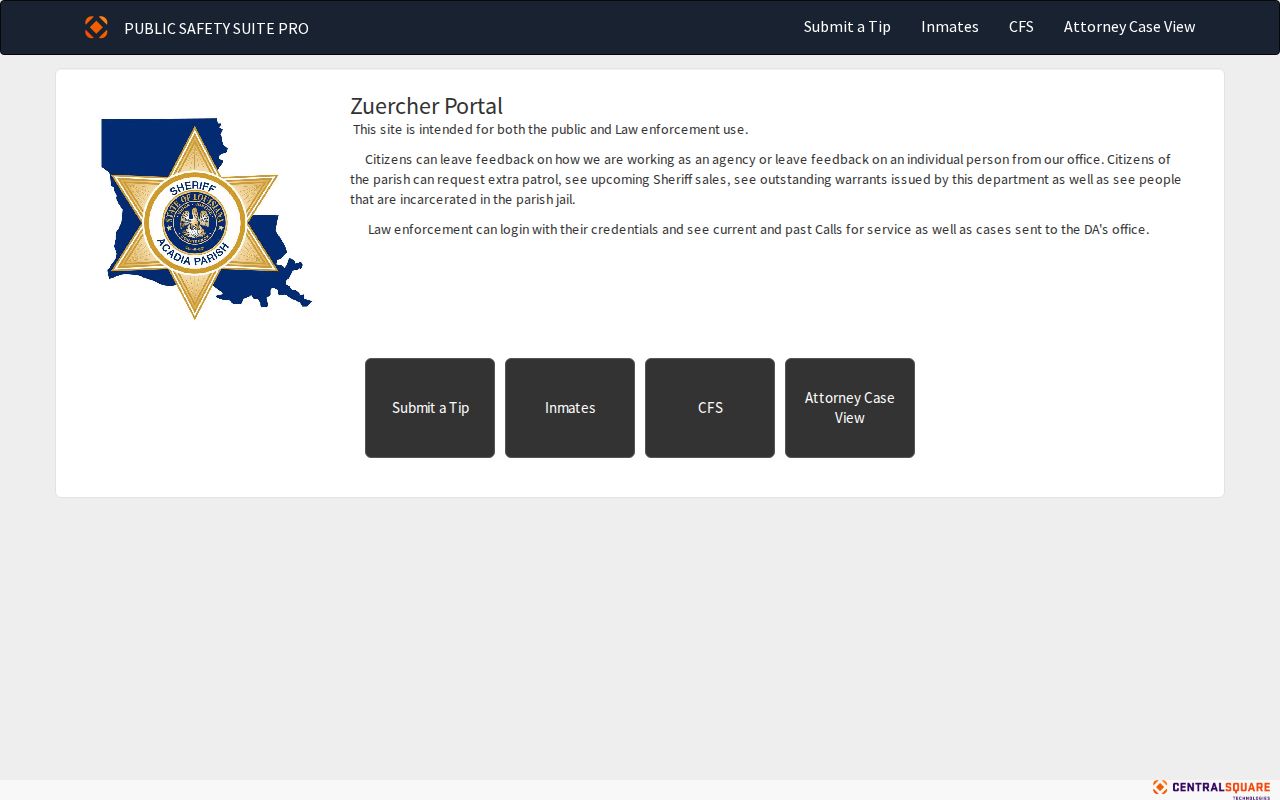
Note the spelling, arresting agency, and custody status, then confirm fast-changing details with the jail.
How to Look Up Acadia Parish Arrests
No single channel covers custody, narrative, court result, and statewide fingerprint history. Use the following chain and keep dates separate. An arrest date is not a filing date, and release is not a dismissal.
- Search APSO Zuercher and Acadia LAVNS by name or alphabet, noting any update stamp.
- Call the jail at 337-788-8737 or 337-788-8735 when a recent transport or spelling variation is missing.
- Identify the arresting agency and request its arrest or incident report.
- After the referral period, check the correct city court or the Acadia Parish clerk for a filed case.
- For your own Louisiana fingerprint-linked history, use LSP Bureau of Criminal Identification and Information Right to Review through Louisiana Applicant Processing Solution fingerprint capture.
A formal Louisiana Public Records Law request should name the exact report, date, location, person, desired format, and specific supplements. Ask for the legal basis when material is withheld.
Which Agency Owns the Narrative?
APSO records can be requested through the sheriff at 1037 Capitol Avenue, Crowley, 337-788-8700. Crowley Police uses 337-788-4114 and thebert@crowleypolice.com or request@crowleypolice.com. Rayne Police is at 100 West Oak Street, 337-334-4215, raynepd@rayne.org. Church Point Police is at 102 North Main Street, 337-684-5455, with the town custodian as fallback.
| Event source | First request | Next record |
|---|---|---|
| APSO arrest | Sheriff report and booking | District or other issuing court |
| Crowley arrest | CPD narrative | APSO custody, then city or district court |
| Rayne arrest | RPD narrative | APSO custody, then Rayne City Court or district clerk |
| Church Point arrest | CPPD or town custodian | APSO custody, then mayor's court or district clerk |
Louisiana State Police records requests use GovQA, while state crash reports use the separate crash report portal. A crash report is not a booking or court disposition.
What an Arrest Record Shows
Public roster content is only a subset of the intake file. Acadia LAVNS confirms name, date of birth, race, gender, and arrest date, plus an offender count, update stamp, profile link, and anonymous notification registration. Additional Zuercher fields must be verified on the live result rather than assumed.
| Identity | Name and limited descriptors used to distinguish the person. |
|---|---|
| Arrest date | The recorded arrest date, which may differ from court filing. |
| Arresting agency | The office that owns the underlying report. |
| Charge or warrant | An intake allegation, subject to later prosecutorial change. |
| Bond or status | Fast-changing custody information that should be confirmed. |
| Booking image | Release was not verified as a universal public field; no private image is republished. |
| Release | A custody event, not proof of dismissal or acquittal. |
Recent Arrests and Booking Logs
Acadia LAVNS provides an alphabetical roster with A through Z and number filters, while Zuercher serves as APSO's current population portal. LAVNS also supports anonymous custody-status notification. Louisiana VINE adds statewide searches by location, name, and ID or case number, updates about every 24 hours, and may include community supervision.
If an online list is stale or blank, call APSO Corrections. The verified sheriff corrections system has 190 beds and processed more than 2,700 people in 2016, but that dated workload figure is not a current arrest rate. State directories separately label Acadia Parish Detention Center at 1061 Capital Avenue, 337-788-8740, Acadia Parish Jail at 337-788-8737, and Rayne City Jail at 200 Oak Street, 337-334-4215. Do not assign the 190-bed figure to each listed facility.
Louisiana Custody Beyond Acadia
A person transferred into state custody may no longer appear in a parish current-population result. Call Louisiana DPS&C at 225-383-4580 with the name and date of birth or DPS&C number to ask for housing assignment, facility address and phone, or projected release date. LAVNS assistance is available at 866-528-6748.
The official Louisiana inmate information instructions explain the state locator route.
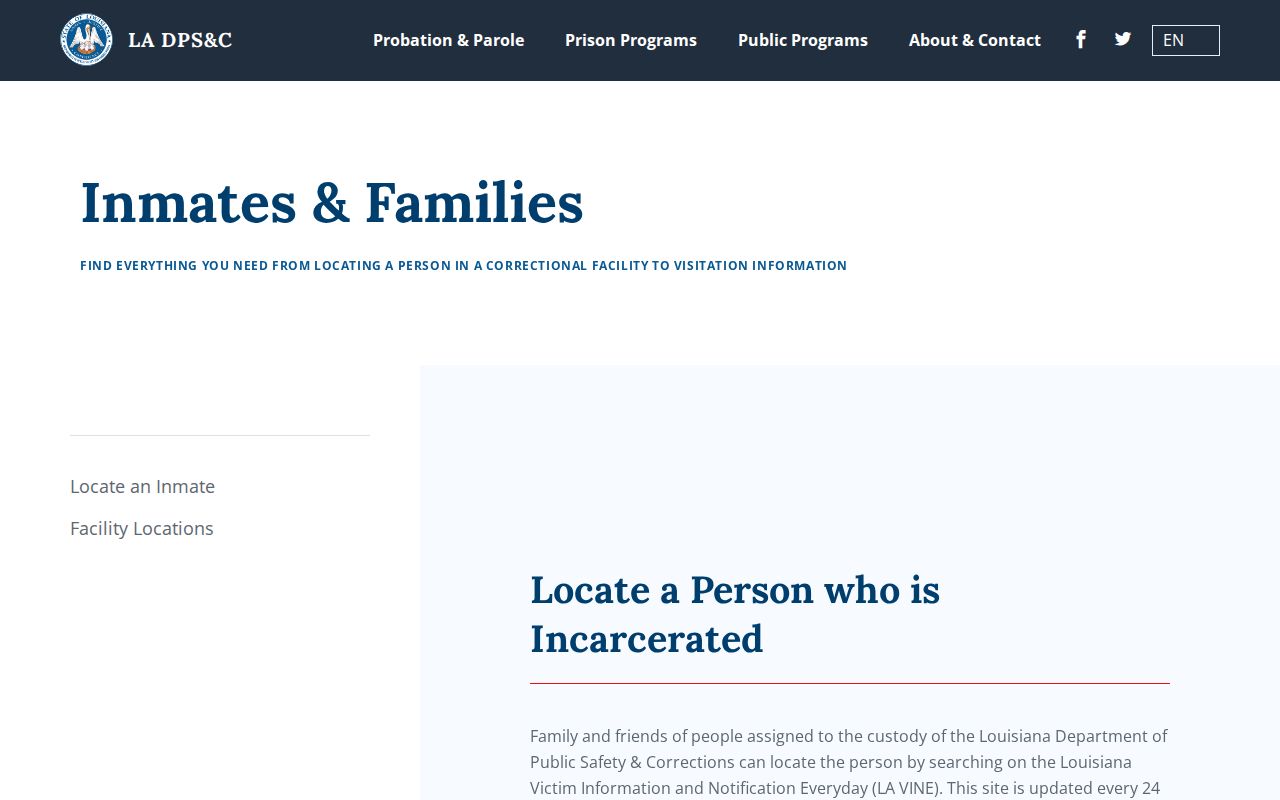
This state channel answers custody questions after transfer, not who created the arrest report or how a parish charge ended.
Acadia Jail Directory Labels
Facility names matter when a family member is trying to locate someone. Ask staff which directory label and phone apply to the present housing assignment. The sheriff's public iOS app, “Acadia Parish Sheriff's Office,” advertises nonemergency reporting, tips, news, and alerts, but its description does not confirm an inmate or warrant search. Do not treat the app as a roster unless the live app proves that function.
The DPS&C Acadia jails and offices directory supplies the official facility listings.
Call the listed facility when an online roster and expected location conflict.
The Acadia Arrest-to-Case Gap
Jail personnel identify, photograph, fingerprint, screen, and classify the person after transport. Bond or an initial appearance can follow. Meanwhile, the arresting agency completes its report. The district attorney says an agency file commonly reaches the office four to six weeks after arrest, then commonly receives review within 30 days after assignment.
The prosecutor can file, decline, divert, amend, or seek indictment. Only a filing opens the district clerk's case. This explains why a booking can be visible for weeks without a matching docket. It also explains why a booking charge should never be copied forward as though it were the final court charge.
Once filed, the clerk's minutes become the better source for arraignment, plea, motion dates, trial, disposition, and sentence. If the statewide fingerprint record later lacks the outcome, do not fill the gap from a roster. Obtain an original certified disposition that includes identifying facts, the matching arrest date, all original and amended charges, each result, and the sentence. Multi-count events require a disposition for every count.
Requesting Acadia Police Reports
Ask for the arrest report or narrative, supplements, CAD entries, 911 audio, and photo or video only when those items are relevant. Request an estimate and the reason for any withholding. Active investigations, juvenile material, victim data, and private identifiers may be restricted. APSO's Part 107 drone disclosure does not make all drone footage public automatically.
Church Point offers unusually concrete terms: a written letter or counter request to the custodian, free inspection in the custodian's presence, and stated copy prices of $0.25 for letter-size and $0.30 for legal-size pages. Confirm the charge before ordering. Municipal report requests stay with the municipality even when APSO performed the booking.
Arrests vs Convictions
A booking proves that an intake event was recorded. It does not prove guilt. The court file is the source for whether the prosecutor filed, changed, or dismissed charges and whether a judge or jury reached a result.
| Arrest record | Conviction record |
|---|---|
| Created by police and jail | Created through the court |
| Shows allegation and booking | Shows a finding and sentence |
| Lives with agency and APSO | Lives with the clerk and may reach BCII |
| Can remain after no filing | Can later be appealed, set aside, sealed, or expunged |
Note: An arrest is not proof of guilt, and an online absence is not proof that no arrest occurred.